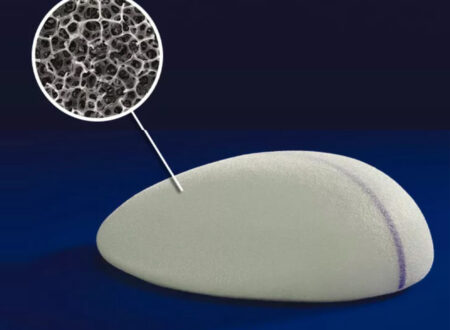
Breast augmentation is one of the most popular requests in the field of cosmetic surgery. It is loudly spoken about everywhere – in glossy magazines, on women’s forums, and, understandably, on the advertisments of cosmetic surgery clinics themselves. At Alpha Cell Clinic, we receive such inquiries virtually on daily basis, so today we will dig into this hot topic and try to highlight all the intricacies and nuances. And there’s quite a lot to cover.
Initially, the idea of fat transfer from one body area to another caused a real frenzy that still hasn’t subsided. The idea of “losing weight in one place and gaining volume in another” doesn’t just look attractive, it even seems magically enchanting. Understandably, one of the most obvious areas for transferring adipose tissue is the breast. Therefore, the question of choosing the breast correction technology is particularly acute: lipofilling or breast implants? In other words, many patients who decide on breast correction face a dilemma: use their own biomaterial (fat) or implants?
The procedure of breast augmentation through implants is called mammoplasty. If the patient’s own adipose tissue is used for breast augmentation, such a procedure is called lipofilling or liposculpture.
The technique of lipofilling involves multiple microinjections into various points of the targeted area.
The most important thing to know about lipofilling is that the larger the amount of transferred adipose tissue at a time, the worse is survival rate of grafted cells, and the prognosis regarding long-term volume improvement becomes less certain. The transplanted tissue must be carefully placed so it is surrounded by microvessels and “native” breast tissue. Otherwise, it does not fully integrate – the fat cells either resorb or break down and are later replaced by connective tissue (which, of course, degrades overall breast texture and feeling).
This is why eventual transplantation of small portions of adipose tissue is considered favorable. If fat is injected all at once during liposculpture, the chances of successful integration are alarmingly low.
Hence the conclusion. Breast liposculpture is an advanced technology with promising potential, but as of now is considerably limited and suitable for correcting minor aesthetic defects. For instance, lipofilling works well when you want to slightly increase breast size or when there’s a contour defect or slight thinning of the covering tissues above the implant after breast augmentation surgery (making the implant visible). In such cases, local transplantation of a small volume of adipose tissue to camouflage the aesthetic imperfection is a viable solution.
In case of radical augmentation, when the patient wants to “jump” from a size 2 to a size 4, it is wiser to choose implants. This way, you achieve a reliable and virtually instant result. Implants are selected individually for each patient, taking into account individual anatomical and physiological features, and personal vision of the desired outcome.
Truth be told, liposculpture is sometimes attempted in such cases as well. However, the procedure is not straigthforward, as it involves a course of consecutive interventions, with poor predictability and reliability of the effect in the long term.
When “size matters,” liposculpture significantly lags behind implantation. Implantation achieves almost any desired result instantly (even up to size 5), with a guarantee of no loss of volume or any other unforeseen situations in the future. With lipofilling, even an experienced surgeon cannot accurately predict the degree of grafted fat survival, and therefore, the future breast size. Some fat may resorb, some may integrate.
Certain nuances regarding mammology may arise due to breast liposculpture. Experts warn that introducing adipose tissue through lipotransfer significantly reduces the effectiveness of breast cancer diagnostics. Transferred fat may consolidate in structures masking benign and malignant formations. Mammography after such intervention may not be able fully reflect the entire picture of what is happening in breast, and even more advanced techniques like MRI may not be sufficient for proper diagnostics. Silicone breast implants do not interfere with mammography and thus are generally considered to be a better option.
Breast cancer screening is one of the main methods of early diagnosis and prevention, which undeniably saves thousands of lives worldwide. It is generally recommended to use implants for breast augmentation, and, of course, not to neglect undergoing regular mammography.