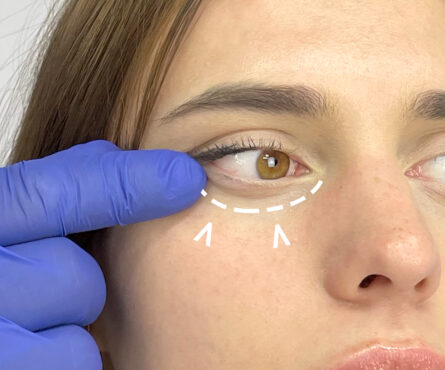
Lower Blepharoplasty, also known as lower eyelid correction surgery, is an umbrella term, that unites a variety of surgical techniques that target the lower eyelid and collateral area. This category of cosmetic surgery rejuvenates upper face significantly and makes one’s glance more pronounced and clear. Such aesthetic surgery deals with eye bags, fat prolapses, large wrinkles and sagged skin.
Typically, this is a relatively simple surgery which lasts up to 1,5 hours. In the course of intervention an incision at approximately 2 mm from the eyelash line, and fat deposits with excessive skin are removed. A suture is placed so there is no visible scar afterwards. This is a classic blepharoplasty approach, another option is the transconjunctival method, where target tissues are accessed through the inner surface of eyelid.
In certain cases blepharoplasty is coupled with lipofilling, where patient’s own fat is used to add volume to the target area.
Common reasons for lower blepharoplasty are prominent eye bags, prominent nasolacrimal groove, fat herniations, lower eyelid skin wrinkling and sagging.
What types of lower blepharoplasty are there?
The two common techniques of lower blepharoplasty are open and closed methods. Open, also known as transcutaneous, is an older and more universal method which is technically simpler, though it is associated with slightly higher risk of complications. On the contrary, closed (transconjunctival) approach is technically more complex, but it offers faster and easier recovery. The disatvantage of this approach lies in its technical complexity – it is not suitable for most patients over 35 years old, since at that stage of life anatomical structures targeted by this approach are fused and cannot be manipulated safely. In any case, both methods are effective and safe, given proper surgical facilities, expert surgeon performing the procedure and compliance with rehabilitation recommendations.
Often lower blepharoplasty is coupled with a course of laser skin rejuvenation procedures in order to achieve synergic visual enhancement effect.


