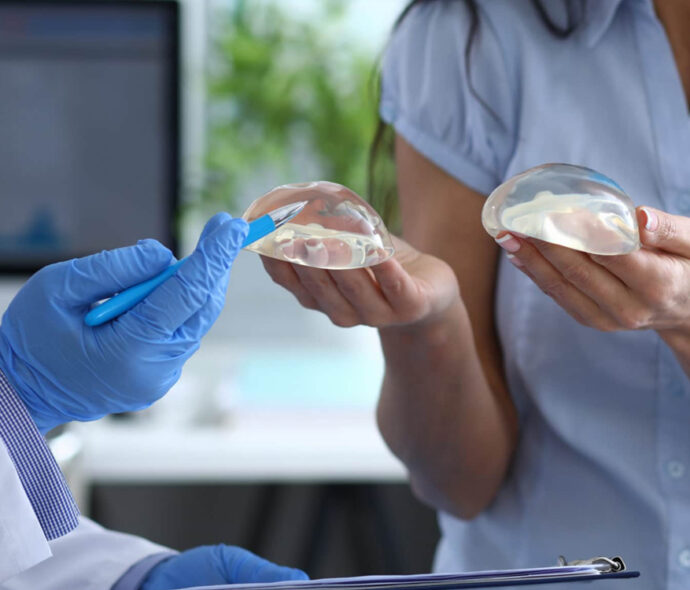
Breast augmentation implants are medical devices placed within the breast tissues, correcting volume and shape. Breast augmentation through implantation requires surgical intervention. A perfect outcome that will give lasting satisfation to the patient requires basic understanding of characteristics and types of breast implants and specialist-assisted decision-making.
Breast implants have various characteristics, each of which must be taken into account when choosing. Let’s examine them in more detail.
Key characteristics of implants:
Round or semi-spherical implants are characterized by a symmetrical shape, the highest point of the dome being located in the center. In addition to increasing the breast volume, they create a push-up effect. They are used if a significant increase in breast size is necessary, to correct postpartum or age-related ptosis. The advantage of round implants is maximum filling of the upper slope of the mammary gland compared to anatomical ones.
Anatomical implants resemble a teardrop shape, with a higher profile at the bottom and a lower at the top. Their appearance is close to the natural form of the breast, so after placement they look as close to natural as possible. Teardrop-shaped implants are recommended for those seeking minor breast augmentation, for breast reconstruction after mastectomy, or for women with a petite stature. However, there is increased risk of significant rotation or transposition of such implants, which may require secondary surgery.
The choice between these types of implants depends on individual needs and features of the patient, and clear communication with the operating surgeon is an unvaluable input at this stage.
Filler
The shells of all implants are made of dense, multi-layered silicone. Various materials are used for their filling.
Silicone gel of varying density
First-generation implants were filled with liquid silicone, which could leak through the shell and penetrate breast tissue. For safety reasons, liquid silicone was replaced with silicone gels of different degrees of cohesiveness (density).
Different manufacturers may have different classifications, but generally, all gels can be divided into 3 density levels:
The advantages of implants filled with silicone gel are their natural appearance, pleasant tactile sensations, and natural behavior during movement. In case of shell rupture, the gel does not migrate beyond the boundaries of the mammary gland, poses no threat to health and can be fixed or replaced through uncomplicated surgical manipulation.
For temporary implants such fillers are applied:
Saline solution – a 0.9% solution of sodium chloride, also known as physiological saline. It is injected into the implant through a special valve during or after its placement, so a smaller incision is required for implantation, when compared to other types of implants. Physiological saline has the same osmotic pressure as human tissues, is neutral to them, so in case of implant shell rupture, it does not harm the body and is gradually expelled from it over time. Another advantage of saline implants is their relatively low cost.
Cons:
Semi-filled implants are also found among temporary implants. They are filled up to 50% with silicone, and the rest of the volume is gradually replenished over several months with saline solution.
There are implants with fillers that do not have international safety certificates, so they are not used in plastic surgery clinics in Rivne.
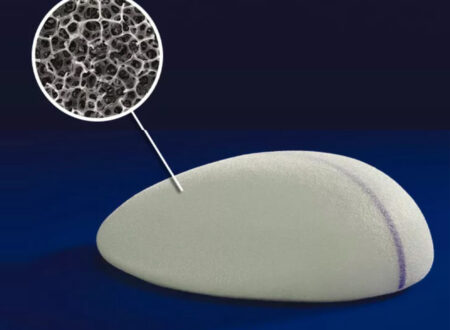
Breast implants can have smooth, microtextured, textured, or nanotextured shells. There are also implants with polyurethane coating.
Implants with smooth transparent shells are gradually becoming obsolete. Their advantages include relatively low cost and easy placement during surgery in the placement pocket. However, the shell of such implants is more prone to ruptures. In addition, smooth implants are more likely to displace and have a higher risk of developing capsular contracture – the formation of tightening around the implant, which deforms its connective tissue capsule.
Textured shell implants have a rough surface. Implants with such shells rarely displace, quickly integrate, and have a low likelihood of developing capsular contracture. The downside of implants with textured shells is that they are stiffer and denser to the touch compared to smooth ones.
The implant profile determines how much the breasts will protrude after its placement. The higher it is, the more convex the breast will look after mammoplasty. Generally, implant profiles are divided into 4 types:
The volume of breast implants is measured in milliliters. In serial production, implants from 100 ml to 800 ml are common, but many manufacturers are ready to produce implants of individual volume and profile.
The materials on the website are provided for informational purposes only and are not intended for self-treatment. Any cosmetic surgery procedure is a serious intervention. Before making a decision about surgery, be sure to consult with a qualified specialist.